
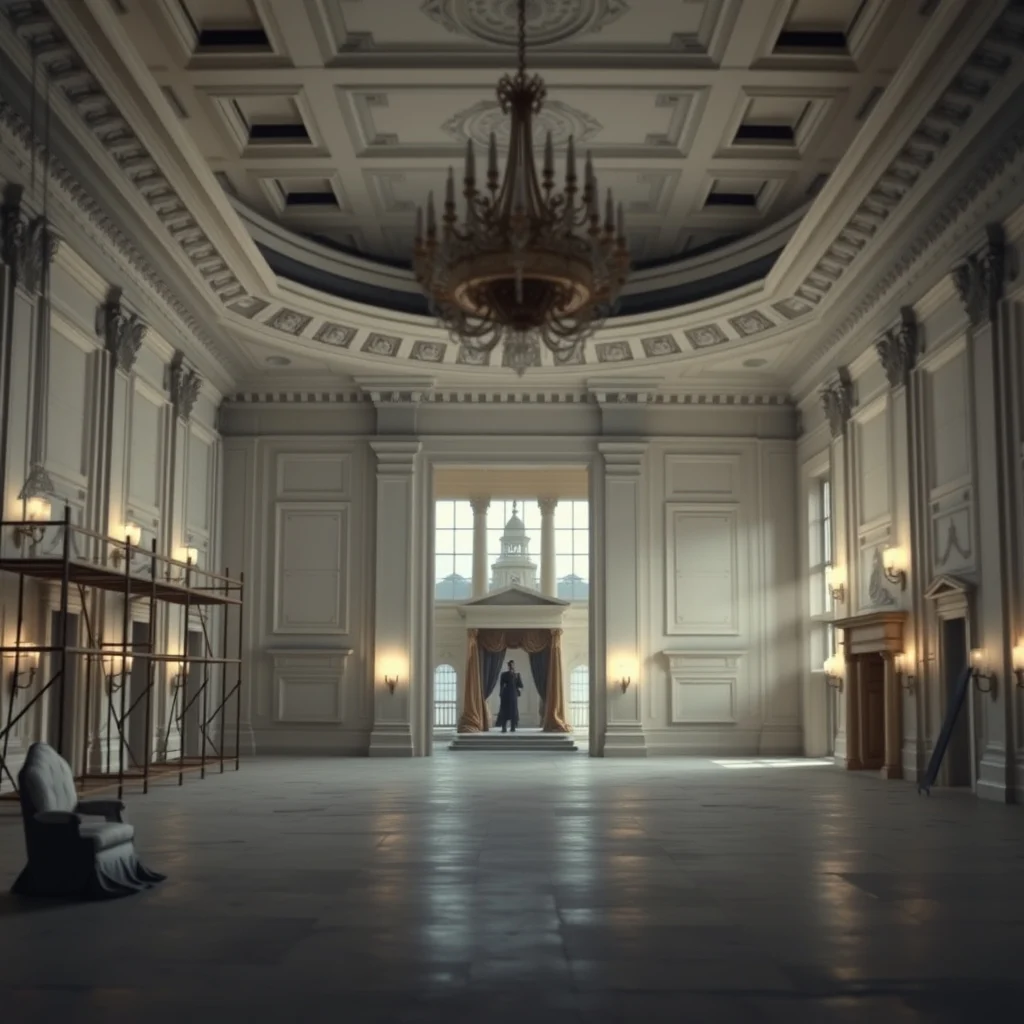
A key Senate official has blocked a proposed funding allocation from a spending package that would have directed taxpayer money towards security upgrades for President Trump’s White House ballroom project. The decision, made on Saturday by Senate Parliamentarian Elizabeth MacDonough, sided with Democrats who argued against using public funds for the initiative.
Background of the Funding Dispute
President Trump has stated that the estimated $400 million ballroom project will be funded by private donors. However, Republicans had sought to include a portion of a $1 billion allocation for Secret Service security upgrades within a larger spending package. This $1 billion provision was intended to bolster presidential safety following a shooting incident at a gala Trump attended in April.
Legislative Maneuvering and Democratic Opposition
Republicans, holding the majority in the Senate, utilized the budget reconciliation process to attempt to pass the bill without Democratic support. This complex procedural tool allows for certain legislation to pass with a simple majority, bypassing the need for bipartisan agreement.
The sweeping package aimed to fund immigration agencies under the Department of Homeland Security. Crucially, it also contained the $1 billion provision for security funds earmarked for the overhaul of the East Wing of the White House, which encompasses Trump’s ambitious ballroom plans. Senate Parliamentarian Elizabeth MacDonough, who has served as a referee in the chamber since 2012, ruled this provision out of order.
Parliamentarian’s Ruling and Rationale
According to Democrats, MacDonough determined that the provision fell outside the jurisdiction of the Senate Judiciary Committee. Furthermore, it was deemed non-compliant with the Byrd rule, a Senate procedure that prevents extraneous, non-budgetary provisions from being included in reconciliation bills.
Senate Minority Leader Chuck Schumer publicly criticized the Republican effort, stating on X (formerly Twitter), “Republicans tried to make taxpayers foot the bill for Trump’s billion-dollar ballroom. Senate Democrats fought back — and blew up their first attempt.” He added that Democrats are prepared to block future attempts, asserting, “Americans don’t want a ballroom. They don’t need a ballroom. And they sure as hell should not be forced to pay for one.”
Republican Response and Future Prospects
A spokesperson for Senate Majority Leader John Thune acknowledged the ruling, noting, “Redraft. Refine. Resubmit. None of this is abnormal during a Byrd process.” This suggests Republicans may attempt to reintroduce the funding request in a modified form.
Senator Jeff Merkley, the top Democrat on the relevant committee, indicated that he anticipates Republicans will seek to alter the bill to “appease Trump.” He affirmed that Democrats remain prepared to challenge any revised proposals.
Broader Context of White House Renovations
The ballroom project is part of a larger trend of renovations and alterations at the White House under the Trump administration. Construction crews began demolishing the East Wing in October to facilitate Trump’s vision for what he described as the “finest ballroom of its kind, anywhere in the world.”
The National Trust for Preservation has filed lawsuits challenging the legality of the demolition and subsequent changes without congressional approval. While an appeals court ruled in April that construction could proceed, the legal challenges highlight ongoing controversy surrounding the project.
This initiative aligns with Trump’s broader efforts to update spaces within the U.S. capital, drawing on his background in real estate and construction. Previous modifications include the addition of gold details to the Oval Office and the replacement of the Rose Garden with a patio inspired by his Mar-A-Lago club. He has also pursued renaming institutions and proposed a large triumphal arch near Arlington National Cemetery.
Looking Ahead
The parliamentarian’s decision represents a significant, albeit potentially temporary, victory for Democrats in their efforts to prevent taxpayer funding for the White House ballroom. Republicans are expected to explore alternative legislative strategies to secure the funds, potentially through different budget vehicles or by modifying the current proposal. The ongoing legal battles and public scrutiny surrounding the East Wing renovations will likely continue to shape the discourse around presidential projects and the use of public funds.










Leave a Reply