
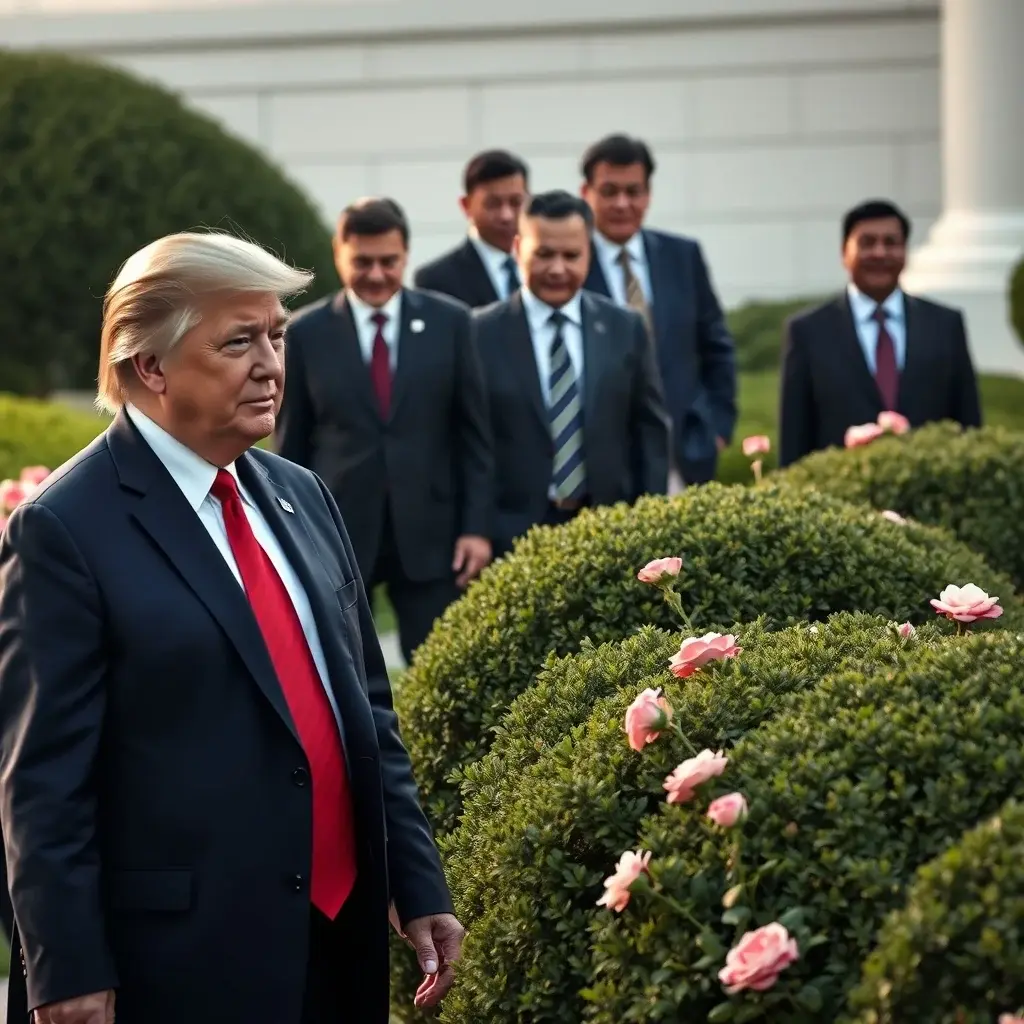
U.S. President Donald Trump concluded a high-stakes summit with Chinese President Xi Jinping in Beijing on Friday, marked by elaborate ceremonies and personal overtures but lacking the substantial structural agreements initially anticipated. While President Trump declared “fantastic trade deals, great for both countries” upon departure, the disparity between the White House’s optimistic portrayal and Beijing’s reserved response underscored persistent underlying tensions in the world’s most consequential economic relationship.
High Stakes and Heavy Hitters
The summit’s agenda prominently featured high technology, with the presence of industry leaders like Elon Musk and Nvidia CEO Jensen Huang signaling the critical importance of the electric vehicle and semiconductor sectors. Huang’s inclusion, not initially planned, fueled speculation about discussions concerning chip access.
Both leaders projected an image of warmth, a stark contrast to recent years of animosity. They engaged in a stroll through the Zhongnanhai gardens, with President Trump admiring roses and President Xi offering to send him seeds, a gesture of reciprocity for Trump’s 2017 visit to Mar-a-Lago.
However, the delegation of 17 CEOs was notably smaller than the 30-strong group from 2017, which saw $250 billion in deals announced. The opulent state banquet, featuring an instrumental version of “YMCA” and a menu of Beijing roast duck and lobster, served as a backdrop to these underlying economic realities.
The Boeing Question and Energy Aspirations
A significant, albeit unconfirmed by Beijing, outcome cited by the U.S. was a commitment from China to order 200 Boeing aircraft, marking the first such purchase of American commercial jets in nearly a decade. President Trump announced the deal, stating, “Boeing wanted 150, he got 200.”
China’s Foreign Ministry spokesperson Guo Jiakun offered a more general statement, emphasizing that the “essence of China-US economic and trade relations is mutual benefit and win-win co-operation.” He urged both sides to act on “important common understandings” to stabilize trade ties.
Energy emerged as another area of potential alignment, with President Trump indicating China’s interest in pivoting toward American crude oil to reduce its reliance on Middle Eastern supplies. He noted that China would be investing “hundreds of billions of dollars” in this sector.
Conflict and Convergence in the Middle East
The ongoing conflict involving Iran provided a rare point of diplomatic agreement. Both leaders expressed a desire for stability in the Strait of Hormuz. President Trump stated they “feel very similar on Iran” and highlighted President Xi’s commitment not to provide military equipment to Tehran.
Beijing’s official statement called for a “comprehensive and lasting ceasefire” and the reopening of shipping lanes, noting that the Iran war “should never have happened.” President Trump suggested the U.S. had less dependence on the Strait’s opening than China.
The Taiwan Red Line and Market Access
Beneath the surface of “constructive strategic stability,” Beijing reiterated its firm stance on Taiwan, viewing it as a critical factor in the broader trade relationship. President Xi warned that the “Taiwan question is the most important issue in China-US relations” and that mishandling it could lead to “collision or even conflict.”
While the U.S. readout did not explicitly mention Taiwan, administration officials confirmed the topic was discussed, with both sides reiterating their established positions.
Regarding market access, President Xi assured business leaders that China’s “doors will open wider,” offering “broader prospects” for American firms and calling for expanded cooperation in various sectors.
Intelligence and Innovation Guardrails
Technology remains a significant point of divergence. Treasury Secretary Scott Bessent emphasized the importance of the U.S. maintaining its lead in artificial intelligence, stressing the need for “highest performance calculus where we can get the most innovation and the highest level of safety.”
U.S. Trade Representative Jamieson Greer confirmed that deals on farm goods and beef were “firmed up,” but the extension of the trade truce beyond November remained undecided.
To manage these ongoing frictions, both leaders agreed to establish a “Board of Trade” and a “Board of Investment” to oversee commerce without reopening tariff negotiations.
The Global Ripple: Impact on African Markets
While Washington and Beijing navigated their rivalry, African nations, particularly Ghana and South Africa, find themselves increasingly impacted. China’s recent implementation of a zero-tariff policy for most African nations aims to bolster trade and investment.
This move by Beijing comes as U.S. protectionist measures have pushed African policymakers toward China for economic stability. The zero-tariff policy is expected to benefit key African exports like cocoa. However, concerns about widening trade deficits persist, with Chinese exports to Africa showing significant growth, partly influenced by redirected trade flows due to U.S. tariffs.
Looking Toward September
The summit concluded with an invitation from President Trump for President Xi and his wife to visit the White House on September 24. Trump described the trip as an “incredible visit” where “a lot of good has come of it” and that they “settled a lot of different problems.”
Analysts, however, remain cautious. Ryan Fedasiuk of the American Enterprise Institute noted that many potential deals were not yet “ripe enough.” The upcoming September visit is anticipated to be a full state visit, where the fundamental U.S. desire for concrete purchases will likely continue to be weighed against China’s emphasis on “mutual respect” and “equality.” The coming months will be crucial in determining if the optimistic rhetoric translates into tangible outcomes.










Leave a Reply