
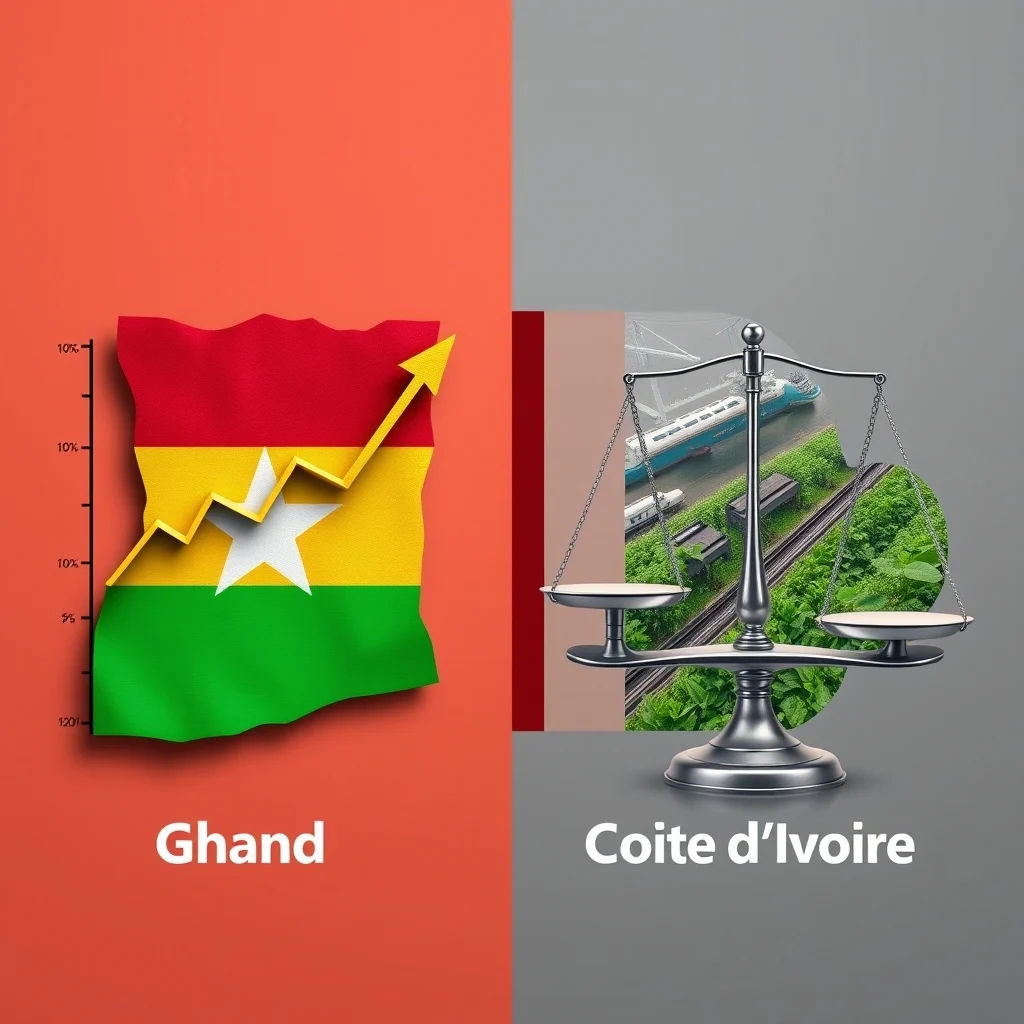
Ghana’s Gross Domestic Product (GDP) is projected to surpass that of its West African neighbor, Côte d’Ivoire, by 2026, according to International Monetary Fund (IMF) forecasts. This economic shift comes as Ghana demonstrates significant recovery following a period of severe crisis and debt restructuring, while Côte d’Ivoire has maintained steadier growth.
Ghana’s Economic Recovery and Debt Management
The Ghanaian Ministry of Finance recently settled a $709 million Eurobond ahead of its maturity date, a move signaling improved economic health and debt management capabilities. In 2025 alone, Accra is set to repay $1.4 billion to creditors, marking a crucial step in its economic recovery.
Ghana’s economic journey has been challenging. In 2020, substantial government spending to combat the COVID-19 pandemic led to a surge in debt, peaking at 93% of GDP. This fiscal pressure resulted in Ghana losing access to international financial markets.
The situation was further exacerbated by the war in Ukraine, leading to Ghana’s default. Consequently, the country secured an IMF program in 2024, which necessitated a painful debt restructuring process.
Côte d’Ivoire’s Steady Performance
During Ghana’s crisis, Côte d’Ivoire navigated the economic landscape more smoothly. It was one of the few nations to avoid recession in 2020 and was the first in sub-Saharan Africa to return to financial markets in January 2024 after the global crisis.
The IMF projects Ghana’s GDP to reach $118 billion this year, exceeding Côte d’Ivoire’s projected $110 billion. However, this projected GDP milestone does not solely define the economic performance of these two West African economic powerhouses.
Comparing Growth Dynamics and Inflation
For over a decade, Côte d’Ivoire has consistently recorded strong GDP growth, typically between 6% and 7% annually, positioning it among the world’s top-performing economies. Ghana also exhibits solid growth, averaging 5% to 6% in recent years, though its trajectory has been more volatile.
Ghana experienced significant expansion in the 2010s, with growth reaching up to 14% in 2011, largely driven by hydrocarbon exploitation. However, the economy contracted sharply in 2022, with growth falling to just 0.5%.
A key differentiator remains inflation. While Côte d’Ivoire has maintained inflation around 2% to 3%, Ghana grappled with rates exceeding 50% in 2023 before a recent decline below 4% by early 2026. This achievement follows a period of strict austerity measures in Ghana.
Dependence on Raw Materials and Diversification Efforts
Both economies remain significantly dependent on raw material exports. Ghana is Africa’s largest gold producer, with gold accounting for approximately 15% of its GDP and over 60% of its exports. Cocoa and crude oil also form substantial parts of its export revenue.
Côte d’Ivoire leads the world in cocoa production, supplying about 40% of the global market, with cocoa beans constituting roughly a third of its export sales.
However, Côte d’Ivoire has actively pursued economic diversification. The nation has been developing local processing of cocoa and other agri-food industries. This trend is reflected in company rankings, where Côte d’Ivoire has more diverse businesses listed compared to Ghana, which has a higher concentration in extractive sectors.
Ivorian exports of processed goods now represent over 40% of its total sales. Furthermore, the service sector, bolstered by construction, contributes more than 50% to its GDP, indicating a transitioning economy.
Infrastructure Investment and Foreign Direct Investment
Côte d’Ivoire has demonstrated a strong commitment to infrastructure development, investing an estimated $20 billion cumulatively between 2021 and 2025. This strategy focuses on major projects in roads, ports, energy, and urban transport.
In contrast, Ghana’s infrastructure investment pace is more moderate, with approximately $5 to $6 billion allocated over the same period. This disparity is reflected in foreign direct investment (FDI) figures.
In 2024, Côte d’Ivoire recorded a record $3.8 billion in FDI, while Ghana attracted $1.7 billion. This gap highlights the differing levels of attractiveness for international investors.
Monetary Systems and Fiscal Discipline
A fundamental structural difference lies in their monetary systems. Côte d’Ivoire utilizes the CFA franc, a currency pegged to the euro, which offers low inflation and stability but limits independent monetary policy adjustments.
Ghana, using its national currency, the cedi, possesses greater monetary policy flexibility. However, this autonomy comes with increased risks, as evidenced by recent currency depreciation and high inflation.
Economic analysts suggest that Ghana’s crisis was partly fueled by significant electoral spending prior to the 2020 elections. Conversely, membership in a monetary union like the West African Economic and Monetary Union (WAEMU) imposes fiscal discipline through shared community standards.
Ultimately, the performance of both economies hinges on robust budgetary discipline, a criterion where Côte d’Ivoire has historically maintained an advantage.
Looking Ahead
As Ghana continues its recovery and aims to return to international financial markets, its ability to sustain fiscal discipline and further diversify its economy will be critical. Observers will watch closely to see if Ghana can leverage its recent economic gains to build long-term resilience and if Côte d’Ivoire can maintain its diversified growth trajectory amidst regional economic shifts.








Leave a Reply